Wordleful

Wordleful was built with a product mindset rather than a feature checklist. Every addition was evaluated based on usability and how it fits into the overall experience.

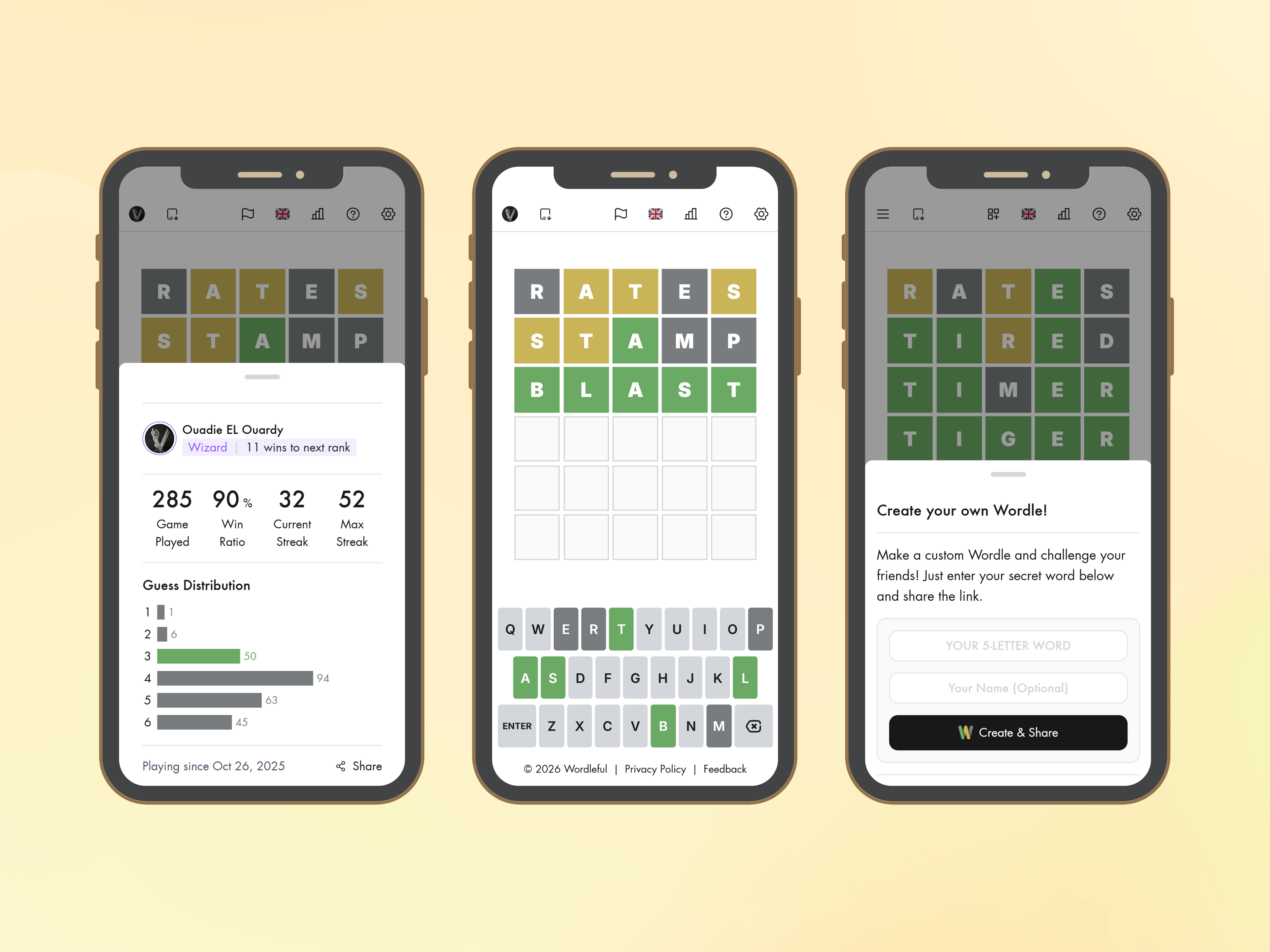
Beyond the core gameplay, Wordleful includes features such as creating custom puzzles that can be shared via URL, user accounts with saved stats, ranking system that tracks player progression over time, multiple visual themes and accessibility options like reduced motion and high contrast mode.

The game is also available as a Progressive Web App, allowing players to install it and play offline with a smooth, native-like experience.


Wordleful

Architecture & extensibility

One of the main design decisions was to make the game logic extensible, especially for language support. Adding a new language typically only requires a word list, a keyboard layout, and UI translation files, as long as the language does not introduce special edge cases.

This approach made it easier to scale the game beyond a single language while keeping the core logic consistent and maintainable.

Key challenges

Multi-language support

Supporting multiple languages introduced additional challenges, particularly for non-Latin languages like Arabic, which require different keyboard layouts and have limited public word lists.

I explored solution that don't require having an explicit word list such as using a language model to validate guesses dynamically, but the added latency negatively affected gameplay. As a result, I relied on curated word lists for major languages and treated AI-based validation as a fallback rather than a primary solution.

How letter colors are determined

Handling letter coloring was the trickiest part of the game logic and took almost the longest time, especially when dealing with duplicate unmatched letters. A simple approach works for basic cases but breaks when a guessed word contains repeated letters that also appear multiple times in the hidden word.

While working on this, I found many discussions on forums and StackOverflow covering the same edge cases. There was no single “correct” solution, as each approach had tradeoffs, so I evaluated the options and chose the one that made the most sense from a player’s perspective.

Testing & reliability

To ensure reliability, I added unit tests for the core game logic, particularly the letter evaluation algorithm. This helped validate edge cases and gave confidence when extending or refactoring the logic.

Final Thoughts

This project helped me better understand how to design and maintain a complete, production-level application. It reinforced the importance of thoughtful architecture, clear tradeoffs, and focusing on user experience rather than just features.

Next Project

Next ProjectALX Code Focus